Human Rights Management Organization
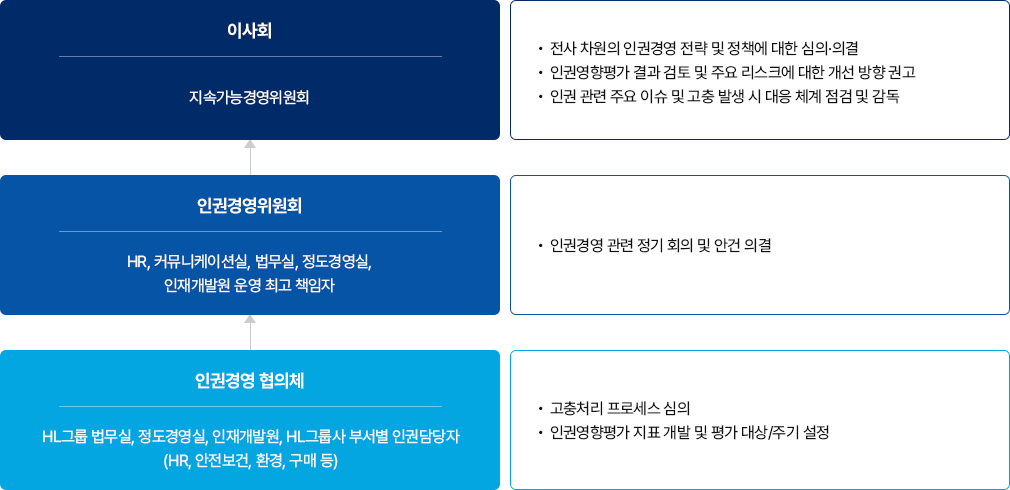
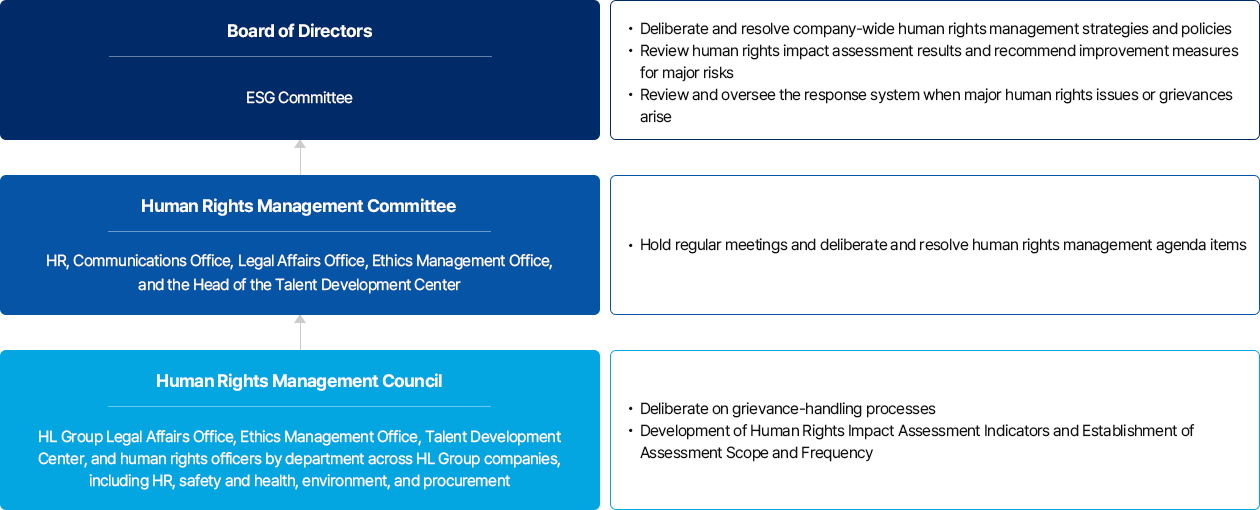
HL D&I Halla has established a human rights management governance system together with other HL Group affiliates. Under this system, the Company plans and implements human rights management activities centered on common Group-wide tasks and operates a Group-level framework for preventing human rights risks. The Group-wide human rights management governance system is designed to complement the response capabilities of individual affiliates and ensure consistent human rights management based on common standards and implementation principles. A council comprising the human rights management working-level organizations of each Group company performs both regular and ad hoc duties, including deliberation on grievance-handling processes and human rights impact assessments. Key agenda items are submitted to the Human Rights Management Committee for deliberation and resolution. Material matters approved by the Committee are regularly reported to the Sustainability Management Committee under the Board of Directors, the highest decision-making body for human rights management, thereby strengthening implementation capabilities and accountability.
Human Rights Management Organization and Roles
Human Rights Management Policy
HL D&I Halla recognizes respecting and protecting stakeholder human rights as a core responsibility throughout all business activities. Based on the labor laws of each country and region, the Universal Declaration of Human Rights,1) and the UN Guiding Principles on Business and Human Rights,²⁾ the Company has established and operates principles for human rights management. These principles are shared internally following approval by top management and apply to all stakeholders, including customers, employees, shareholders and investors, partner companies, and local communities.
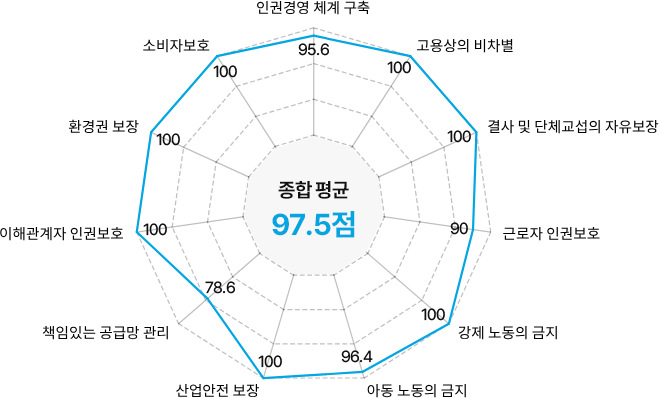
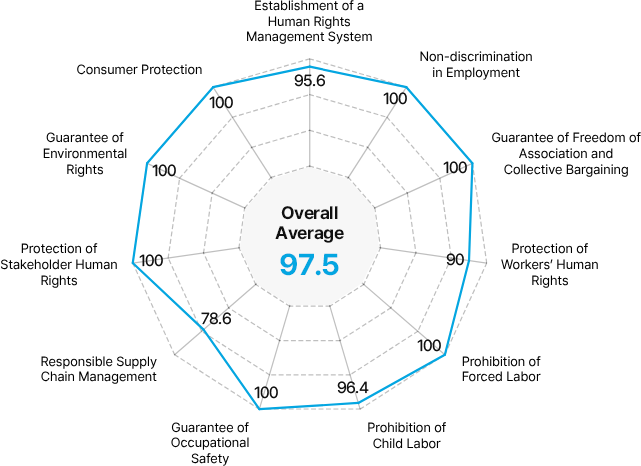
The Company promotes systematic management activities to create a discrimination-free workplace, expand diversity and inclusion, and prevent human rights violations. To effectively manage human rights risks across its operations, HL D&I Halla conducts regular human rights impact assessments covering headquarters, worksites, and partner companies. It also performs on-site human rights due diligence at high-risk worksites to identify potential risks and advance its management system. In addition, the Company responds promptly and fairly to human rights issues through grievance-handling channels and strengthens the internalization of human rights management through employee education and awareness-building activities.
1) Universal Declaration of Human Rights: A declaration adopted by the United Nations General Assembly in 1948 that serves as a foundational international human rights instrument, affirming the equal rights and freedoms of all people without distinction based on race, gender, language, religion, or other status
2) UN Guiding Principles on Business and Human Rights: International standards unanimously endorsed by the UN Human Rights Council in 2011, covering the state duty to protect human rights, the corporate responsibility to respect human rights, and access to remedy for victims

Human Rights Management Goals and Strategies
HL D&I Halla has established the vision of “Realizing the Value of Respect for Human Rights for a Better Life” and formulated mid- to long-term strategies to advance its human rights management system. Through a phased approach encompassing the establishment of a human rights management framework, expansion of awareness, and strengthened leadership, the Company is creating a management environment in which the human rights of all stakeholders, including employees and partner companies, are respected.
Human Rights Management Strategy
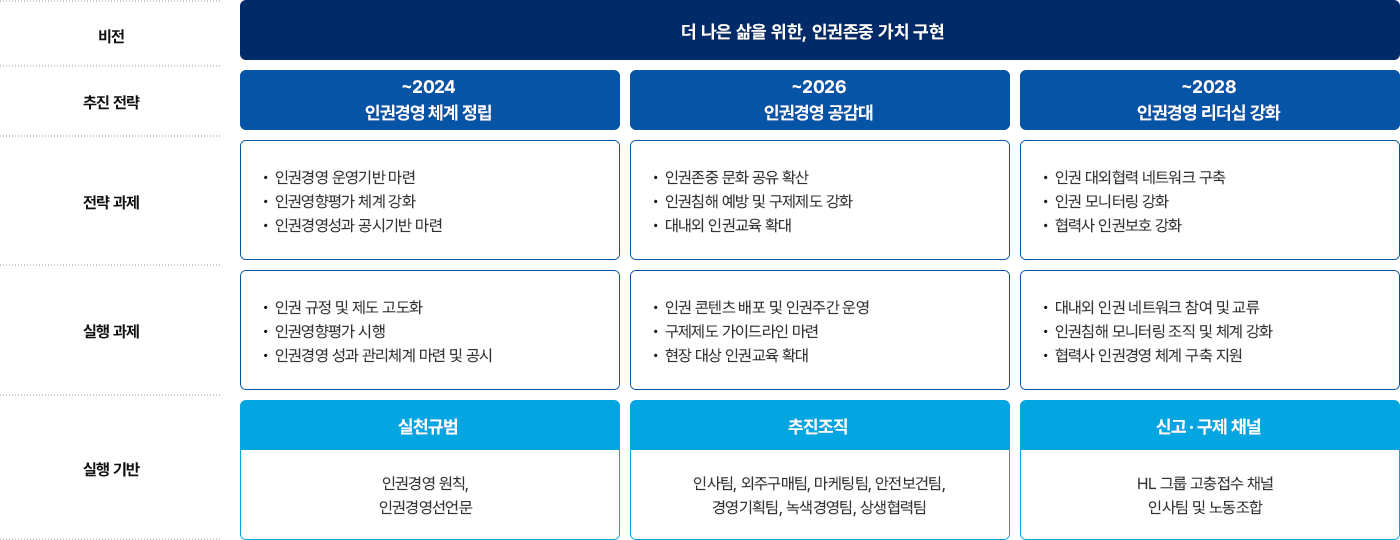
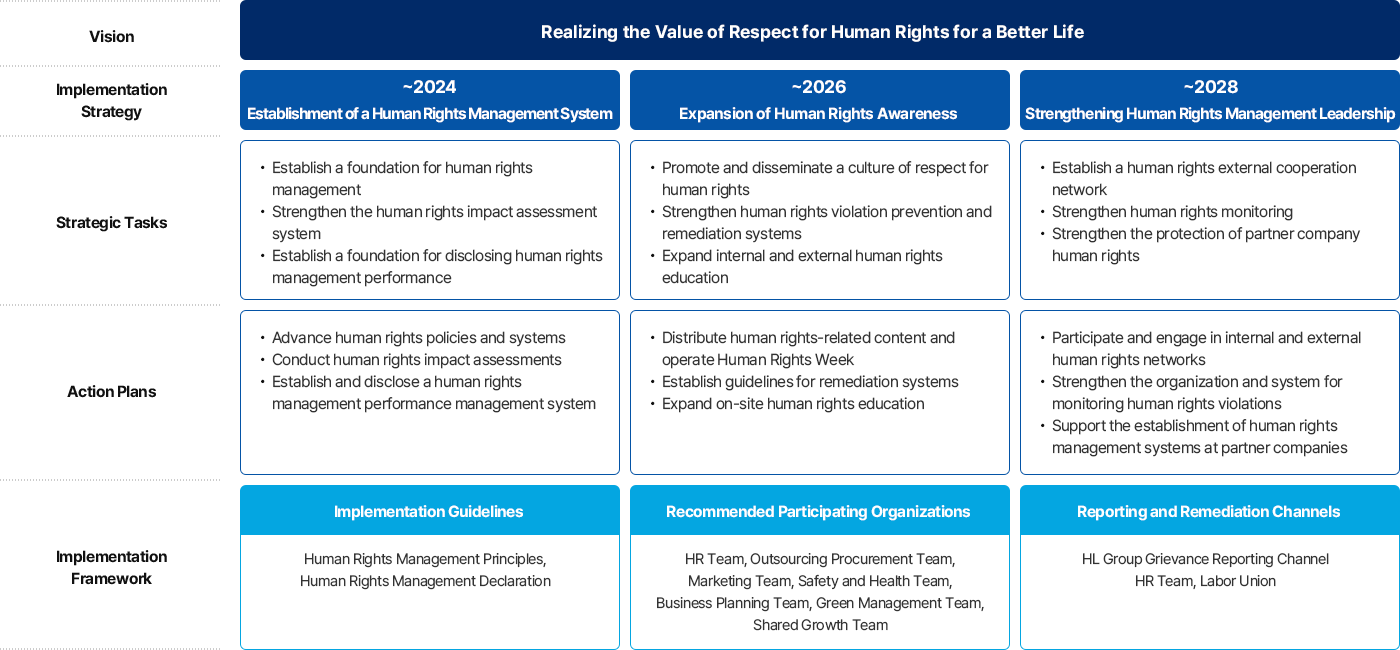
Mid- to Long-term Roadmap for Human Rights Management1)
HL D&I Halla is gradually expanding the scope of human rights impact assessments for partner companies in accordance with its mid- to long-term human rights management roadmap. The Company aims to expand the assessment scope from 10% of partner companies in the short term to 30% in the medium term and ultimately to all partner companies in the long term. It also continues to maintain a 100% completion rate for employee human rights education, thereby strengthening the establishment and internalization of human rights management throughout the organization.
| Category | Short Term | Medium Term | Long Term |
|---|---|---|---|
| Scope of Human Rights Impact Assessments | Expand to 10% of partner companies | Expand to 30% of partner companies | Expand to 100% of partner companies |
| Ratio of Employees Receiving Human Rights Education | 100% | 100% | 100% |
1) Short term, medium term, and long term refer to 2025, 2026–2030, and 2031–2050, respectively.