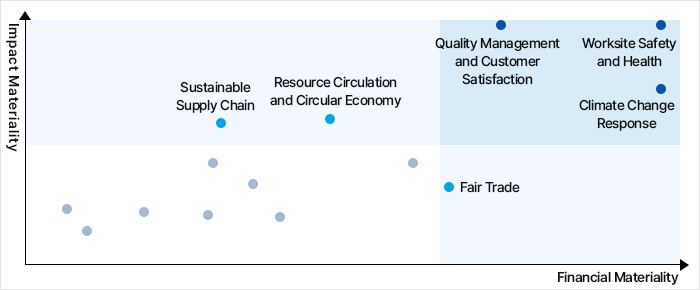
| Worksite Safety and Health |
● |
● |
|
R |
[External Factors]
Stronger punitive measures under the government’s comprehensive occupational safety measures and the Serious Accidents Punishment Act, together with a substantive expansion of prime contractors’ responsibilities
|
[Financial Impact]
Criminal liability for management, restrictions on bidding or contract awards, and increased costs due to project delays resulting from work suspensions following an accident
|
Centered on the ISO 45001-based safety and health management system and the BASIC strategy—Basic Compliance, Awareness of Risks, Information Sharing, Continuous Improvement, and Commitment to Accountability—the Company strengthens compliance with fundamental procedures, intensive management of high-risk work, regular inspections, and its accident prevention system.
Learn More 
|
| ● |
● |
|
P |
[Business Activities] Identification of safety risks in advance and expansion of a preventive safety culture through systems such as the Smart Risk Assessment System
|
[Impact] Improvement of worksite safety and protection of the right to life
|
Through the Smart Risk Assessment System and safety information-sharing platform, the Company identifies and manages high-risk factors in advance and promotes an education- and prevention-centered safety culture.
Learn More
|
| Quality Management and Customer Satisfaction |
|
● |
|
R |
[External Factors] Stronger quality management inspections and expansion of punitive administrative sanctions, including suspension of business operations, for serious defects
|
[Financial Impact] Reduced eligibility for prequalification and bidding restrictions, resulting in lower backlogs for public and private projects and financing risk
|
The Company regularly reviews quality management levels by process through company-wide quality audits and MINE quality inspections. It is also strengthening its construction quality management system by expanding Third-Party Inspections (TPI) and operating technical guidelines for quality construction.
Learn More
|
| ● |
● |
|
N |
[Business Activities] Failure to manage building quality and defects
|
[Impact] Loss of life and damage to the property and mental well-being of residents
|
Through EFETE TIME pre-occupancy quality inspections, the operation of inspection and testing management systems, and the introduction of a mobile construction management system, the Company proactively manages quality risks, prevents defects, and enhances customer satisfaction.
Learn More
|
| Climate Change Response |
● |
|
|
R |
[External Factors] Stricter regulations and greater volatility in major construction material markets due to structural changes in the steel industry and increases in electricity rates
|
[Financial Impact] Increases in presale costs and construction expenses due to rising prices for major construction materials
|
The Company actively introduces materials made from recycled feedstock, recycled aggregates, recycled asphalt concrete, and recycled-content cement materials. It is also establishing a stable construction material supply system through support for subcontractors and stronger long-term partnerships.
Learn More
|
|
● |
● |
P |
[Business Activities] Implementation of decarbonization strategies, including the touchHL AI House Platform, which autonomously optimizes energy consumption
|
[Impact] Reduction of carbon emissions during the building-use phase
|
The Company promotes energy optimization and expands the foundation for household energy self-sufficiency through the introduction of the touchHL smart home service and solar power generation facilities.
Learn More
|