Biodiversity

Biodiversity Management System

Biodiversity Management Governance

HL D&I Halla operates a systematic governance and decision-making structure to protect natural capital, including biodiversity, and manage related risks. The Sustainable Management Committee under the Board of Directors deliberates and resolves matters related to natural capital risk management. It regularly receives reports on key natural capital issues that may affect the Company’s business and financial performance and reviews their alignment with management strategies. Through this process, the Committee oversees the incorporation of natural capital-related risks and opportunities into Company-wide management activities. The Chief Safety Officer (CSO) serves as the central decision-maker for natural capital risk response, reviewing relevant response measures and overseeing decision-making. The Green Management Team conducts natural capital assessments, establishes and implements site-level action plans, and monitors implementation performance. The Green Management Team also identifies areas requiring improvement based on natural capital assessment results and reports them to the CSO. Based on these findings, the CSO reports key matters to the Board of Directors, thereby enhancing the effectiveness of the management system.

In particular, HL D&I Halla focuses on site-based management to minimize potential damage to biodiversity during construction. The Company identifies at an early stage the direct and indirect impacts of construction activities on the natural environment, including damage to flora and fauna habitats and ecosystems, as well as the living environment, including noise and vibration. Based on environmental impact assessment results, the Company establishes response plans and systematically implements biodiversity conservation activities. Going forward, HL D&I Halla will continue to advance its biodiversity management system through an integrated governance structure encompassing the Board of Directors, the CSO, and the Green Management Team, thereby embedding the principles of natural capital protection throughout its business operations.

Biodiversity Principles

HL D&I Halla respects international agreements concerning the use of biological resources and the objectives of the Convention on Biological Diversity. The Company has established and applies management standards to minimize its impacts on ecosystems surrounding its business sites. Through these efforts, HL D&I Halla practices environmental management aligned with global guidelines while establishing a foundation for balancing the conservation of local ecosystems with the sustainable use of resources. The Company has established three core principles to systematically implement biodiversity conservation activities and focuses on creating a long-term foundation for ecosystem protection. HL D&I Halla also embeds awareness of the importance of biodiversity conservation through employee training and expands the foundation for environmental protection practices through continuous communication with local communities and key stakeholders. Going forward, the Company will proactively assess potential environmental impacts arising from its business operations and continuously implement protection measures and risk-mitigation activities, thereby creating leading practices in natural capital conservation and sustainable ecosystem management.

HL D&I Halla Biodiversity Principles

  • 1. Identify biodiversity impacts that may arise at all stages of business activities and strive to prevent or minimize such impacts.
  • 2. Identify threats to endangered flora and fauna found in areas where the Company’s business sites and suppliers are located, continuously monitor such species, and establish strategies for their conservation.
  • 3. Promote and expand investments and activities for the conservation, restoration, and enhancement of biodiversity and actively participate in international biodiversity-related initiatives.

Biodiversity Strategy

HL D&I Halla recognizes that conserving natural capital is essential to ensuring its long-term resilience and sustainability and operates a management system designed to minimize adverse impacts on nature throughout all stages of its business activities. In particular, the Company reviews potential ecosystem impacts from the early stages of project planning and development, thereby establishing a foundation for proactive response. HL D&I Halla also conducts environmental impact assessments before commencing all development projects to identify biodiversity-related impacts in areas surrounding its business sites. Based on the assessment results, the Company establishes and implements protection and mitigation measures.

Step 1

Environmental Impact Assessment

  • Identify environmental impact assessment factors
Step 2

Establishment and Implementation of Mitigation Measures

  • Biodiversity conservation activities
  • Biodiversity conservation training
Step 3

Continuous Improvement Measures

  • Monitor the ecological environment, including legally protected species
Step 4

Management and Monitoring

  • Conduct external consultations and other relevant activities

LEAP-based Natural Capital Risk Analysis Process

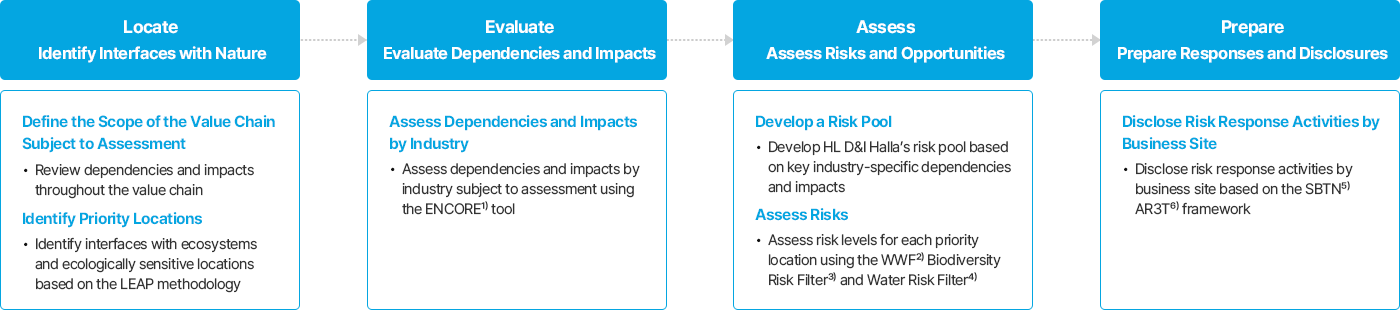
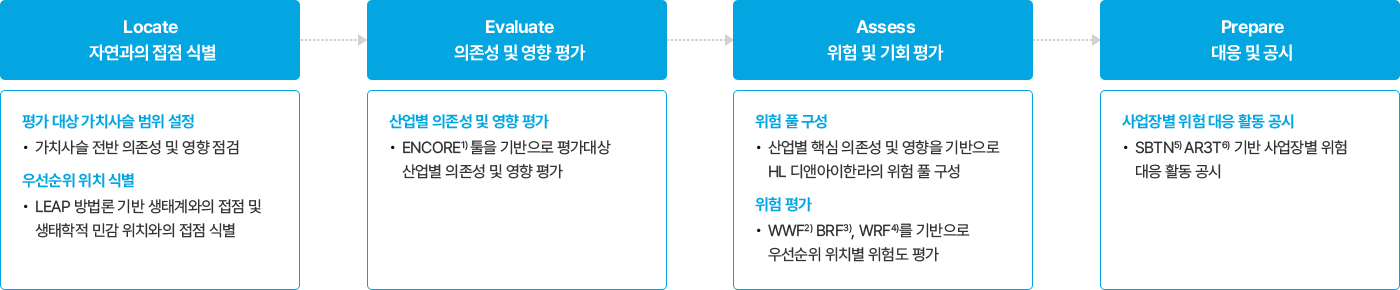
To respond to international requirements and global disclosure standards, HL D&I Halla applied the LEAP approach to examine its dependencies and impacts on natural capital throughout the value chain and identify key natural capital risks. The Company also applied the AR3T framework of the Science Based Targets Network (SBTN) to advance its natural capital risk response system. Going forward, HL D&I Halla will continue to systematically manage natural capital-related issues based on global frameworks.

1) ENCORE(Exploring Natural Capital Opportunities, Risks and Exposure): A tool developed by the Natural Capital Finance Alliance to assess dependencies and impacts on natural capital.

2) WWF(World Wildlife Fund): An independent global environmental conservation organization working toward a future in which people and nature thrive together.

3) BRF(Biodiversity Risk Factor) : A tool that helps companies and financial institutions identify, explore, assess, and respond to biodiversity-related risks.

4) WRF(Biodiversity Risk Factor) : A tool that helps companies and investors explore, assess, and respond to water-related risks.

5) SBTN(Science Based Targets for Nature): An initiative that supports companies in setting science-based targets for biodiversity and nature conservation.

6) AR3T: An approach for minimizing corporate impacts on nature and restoring ecosystems, comprising Avoid, Reduce, Restore and Regenerate, and Transform.

Interface with Nature (Locate)

① Review of Value Chain Dependencies and Impacts

To identify where nature-related dependencies and impacts are most likely to occur, HL D&I Halla examined its entire value chain and identified business sectors with the potential to have medium or high levels of dependency and impact on nature. For this purpose, the Company used the Materiality Screening Tool provided by the Science Based Targets Network (SBTN)¹⁾ to analyze material environmental pressures²⁾ by sector. The analysis found relatively high levels of environmental pressure in the metals and mining and construction materials sectors of the upstream value chain, as well as in the building construction and infrastructure sectors of the Company’s direct operations. Accordingly, these sectors were identified as the principal nature-related dependency and impact areas within the value chain. Of these, the direct operations segment, for which data availability was relatively high, was selected as the scope of the LEAP analysis. Going forward, HL D&I Halla plans to expand the scope of business sites subject to assessment while advancing its natural capital data management system.

1) SBTN(Science Based Targets Network): A global coalition that provides science-based guidance and analytical tools enabling companies and cities to set and implement quantitative targets for natural capital, including land, freshwater, oceans, and biodiversity, while remaining within planetary boundaries and meeting societal needs.

2) Environmental pressures: Direct physical pressures exerted by corporate activities on natural systems. Based on the classification framework of the Intergovernmental Science-Policy Platform on Biodiversity and Ecosystem Services (IPBES), SBTN categorizes environmental pressures into five areas: ① land, freshwater, and ocean-use change; ② resource use and exploitation; ③ climate change; ④ pollution; and ⑤ the introduction of invasive alien species. Where the materiality threshold for a category is exceeded, the relevant business sector is identified as a material impact sector with substantial impacts on nature.

Scope of the LEAP Assessment(Direct Operations)

Building Construction

Infrastructure

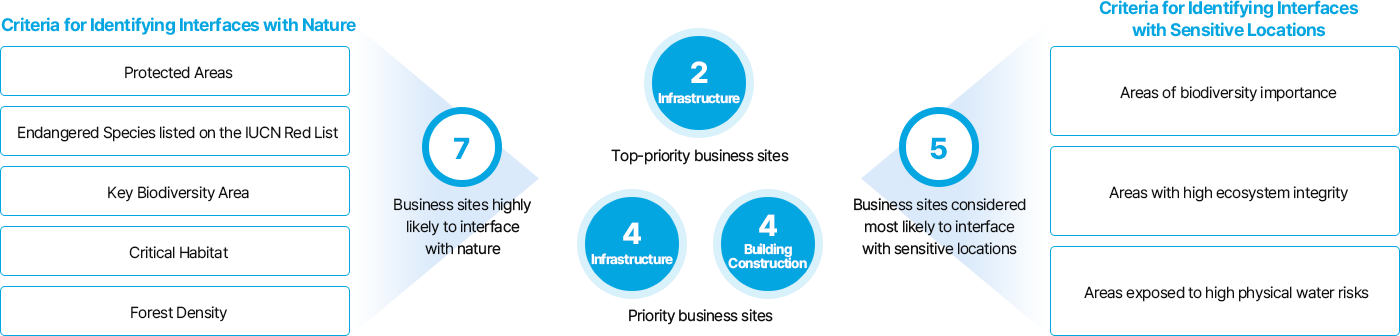
② Identification of Natural Capital-Sensitive Business Sites

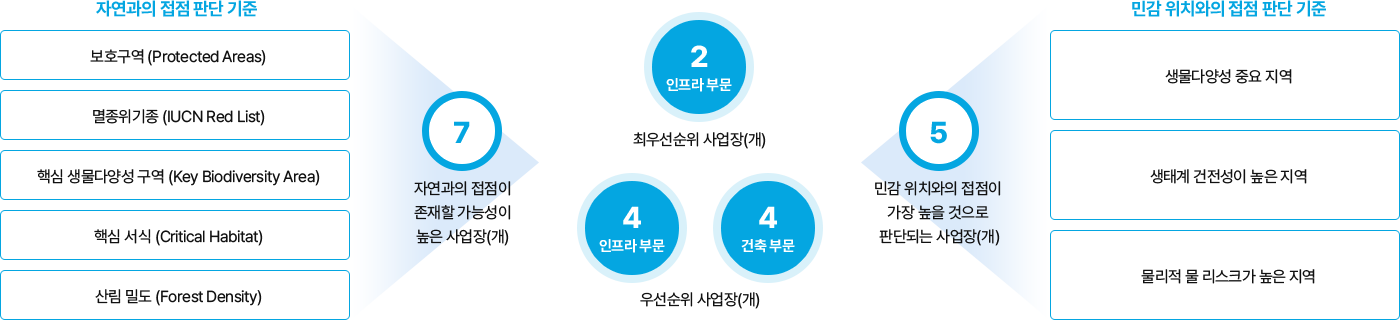
HL D&I Halla examined 46 building construction and infrastructure sites covered by this year’s LEAP analysis to determine whether they interface with nature or sensitive locations. Interfaces with nature were assessed based on the presence of protected areas, endangered species, and Key Biodiversity Areas, as well as proximity to critical habitats and areas with high forest density. Based on these criteria, seven business sites were identified. Interfaces with sensitive locations were assessed in accordance with the LEAP guidance by reviewing whether the sites were located in areas of biodiversity importance, areas with high ecosystem integrity, or areas exposed to high physical water risks. Based on this assessment, five business sites were identified. Consequently, two business sites meeting both sets of criteria were designated as top-priority sites. Eight sites meeting one of the criteria were designated as priority review sites. A total of ten business sites were therefore selected for further analysis.

Dependencies and Impacts(Evaluate)

HL D&I Halla used the ENCORE tool to analyze the levels of nature-related dependencies and impacts associated with its building construction and infrastructure businesses. Dependency refers to the extent to which a company relies on ecosystem services provided by natural capital, while impact refers to the effects of business activities on natural capital. Based on the International Standard Industrial Classification of All Economic Activities (ISIC), the Company reviewed the level of dependency on ecosystem services and the degree of impact for each key industry. Items assessed as Very High or High in terms of dependency or impact were used as baseline data for identifying and assessing natural capital-related risks.

Nature-related Dependencies and Impacts of the Building Construction and Infrastructure Businesses

  • very Low
  • Low
  • Medium
  • High
  • Very High
Category Building Construction Infrastructure
Dependencies Provisioning Services Water Supply Medium Medium
Animal-based Energy Very Low -
Regulation and Maintenance Services Global Climate Regulation Medium Medium
Rainfall Pattern Regulation Very High Very Low
Local Climate Regulation Low Low
Air Filtration Very Low Very Low
Soil Quality Regulation High High
Solid Waste Remediation Very Low Medium
Water Purification Medium Medium
Maintenance of Water Cycle Medium Medium
Flood Mitigation Medium High
Storm Mitigation Medium High
Noise Attenuation Very Low Very Low
Pollutant Dilution by the Atmosphere and Ecosystems Low Low
Mitigation of Sensory Impacts Other than Noise Very Low Very Low
Impacts Disturbances, including Noise and Light Very High Very High
Area of Freshwater Use Medium Very High
GHG Emissions High Medium
Area of Seabed Use Medium Medium
Non-GHG Air Pollutant Emissions Low Low
Generation and Release of Solid Waste Medium Medium
Area of Land Use Low Low
Release of Toxic Pollutants to Water and Soil High High
Water Consumption Low Low
Introduction of Invasive Alien Species Low Low

Risks and Opportunities (Assess)

Based on the results of the Dependencies and Impacts evaluation, HL D&I Halla linked and reviewed indicators from the Biodiversity Risk Filter and Water Risk Filter provided by the World Wide Fund for Nature (WWF) to measure the level of risk at each priority business site. The assessment found that the Release of Toxic Pollutants to Water and Soil scored 4.2 or higher and was therefore classified as Very High. HL D&I Halla plans to address key risks by comprehensively considering these findings together with the environmental impact assessment results for each business site. The Company will also continuously monitor and manage the impacts of its business activities on ecosystem functions. Based on trust with its stakeholders, HL D&I Halla will continue to disclose relevant information transparently and take responsible action.

Material Natural Capital Risk Assessment Results for the Building Construction Business

  • Very Low(1.0~1.8)
  • Low(1.8~2.6)
  • Medium(2.6~3.4)
  • High(3.4~4.2)
  • Very High(4.2~5.0)
Category Mapo-gu, Seoul Suwon-si, Gyeonggi-do Siheung-si, Gyeonggi-do Gujwa-eup, Jeju-si
Physical Risks Flood 3.5 2.5 2.5 2.0
Landslide 3.5 2.5 2.5 3.5
Reputational Risks Ecosystem Disturbance 3.5 3.5 3.5 3.0
Regulatory Risks 3.5 3.5 3.5 4.5
Regulatory Risks GHG Emissions 4.7 4.7 4.7 4.3
Release of Toxic Pollutants to Water and Soil 4.7 4.7 4.7 4.3

Material Natural Capital Risk Assessment Results for the Infrastructure Business

Category Hanam-si, Gyeonggi-do Hwaseong-si, Gyeonggi-do Jinju-si, Gyeongsangnam-do Mokpo-si, Jeollanam-do Buan-gun, Jeollabuk-do Changwon-si, Gyeongsangnam-do
Physical Risks Flood 4.0 2.5 3.0 - 2.5 3.0
Landslide 2.5 2.5 3.5 - 3.5 3.5
Storm 4.0 4.0 4.0 - 4.0 4.0
Reputational Risks Ecosystem Disturbance 3.5 3.5 3.0 3.5 3.5 3.5
Freshwater Use 4.0 4.0 4.0 - 4.0 3.0
Regulatory Risks Ecosystem Disturbance 4.0 3.5 4.5 3.5 4.5 4.5
Freshwater Use 2.0 2.0 2.0 - 2.0 2.0
Reputational and Regulatory Risks Release of Toxic Pollutants to Water and Soil 4.8 4.7 4.3 4.8 4.5 4.3

Response and Disclosure (Prepare)

To minimize biodiversity loss that may arise during construction projects, HL D&I Halla manages and monitors endangered species and legally protected species in areas surrounding its business sites in accordance with the globally recognized SBTN AR3T¹⁾ framework. Even where no direct impacts have currently been identified, headquarters monitors the management status of individual construction sites to proactively respond to potential habitat discoveries and environmental damage risks. Going forward, HL D&I Halla will continue to implement appropriate protection measures for protected species and reduce biodiversity-related risks. Through these efforts, the Company will enhance the value of natural assets and create a sustainable construction environment that actively contributes to achieving the goals of the Kunming–Montreal Global Biodiversity Framework (GBF)2).

Category Meaning Relevant Protection Activities Protected Species GBF Target
Avoid Measures to prevent or eliminate direct impacts on biodiversity in advance Installation of wildlife protection signs Eurasian otter, peregrine falcon Target 1. Plan and manage all areas to reduce biodiversity loss
Prevention of soil and oil runoff during construction
Training for construction workers on legally protected species Eurasian otter, golden eagle Target 4. Halt species extinction, protect genetic diversity, and manage human–wildlife conflict
Reduce Measures to reduce the intensity and extent of unavoidable impacts Installation of silt curtains and other facilities to prevent water pollution Saunders’s gull, Eurasian oystercatcher, Chinese egret, whooper swan, Oriental stork Target 7. Reduce pollution to levels that are not harmful to biodiversity
Minimization of water pollution Protected Species: Eurasian otter
Environmental cleanup activities along the Taehwa River
Restore and Regenerate Measures to restore the functions and structure of affected ecosystems Provision of resting areas Eurasian otter Target 2. Restore at least 30% of degraded ecosystems
Creation of a 1,257 m² Eurasian otter habitat
Capture and release Narrow-mouthed toad Target 4. Halt species extinction, protect genetic diversity, and manage human–wildlife conflict

1) SBTN AR3T — Avoid, Reduce, Restore and Regenerate, Transform: A four-stage action framework used by companies to minimize adverse impacts on the natural environment and restore ecosystems.

2) GBF — Kunming–Montreal Global Biodiversity Framework: An agreement adopted on December 19, 2022 at the 15th meeting of the Conference of the Parties to the Convention on Biological Diversity (COP15) for the conservation and sustainable use of biodiversity. Under the vision of “living in harmony with nature,” representatives of 196 parties agreed on four goals to be achieved by 2050 and 23 action targets to be achieved by 2030.

Best Practice

Creation of a Eurasian Otter Habitat

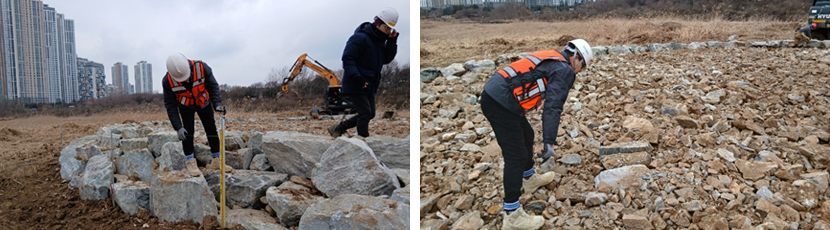
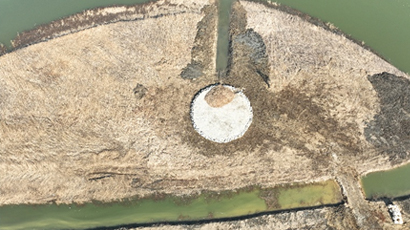
HL D&I Halla places the harmonious coexistence of construction sites and the natural environment among its highest priorities and proactively manages biodiversity risks throughout all stages of its business activities. At the Songsan Green City Pedestrian Bridge Project, which was designated as a top-priority natural capital site due to its high ecological sensitivity, the Company implemented a range of measures to protect the habitat of the Eurasian otter, a legally protected species. To secure an ecological passage for Eurasian otters and support a stable habitat, HL D&I Halla created a 1,257 m² alternative habitat at a location approximately 80 meters from the construction site. A total of 15 employees directly participated in the activity and contributed 45 volunteer hours to improving the habitat environment, sharing the value of respect for life. Going forward, HL D&I Halla will move beyond conventional construction and set a new standard for sustainable construction through Nature Positive management, which supports the resilience of natural capital and enhances biodiversity.

Creation Process for the Eurasian Otter Habitat at the Songsan Green City Pedestrian Bridge Project

Completed Eurasian Otter Habitat

Best Practice

Creation of Ecological Corridors

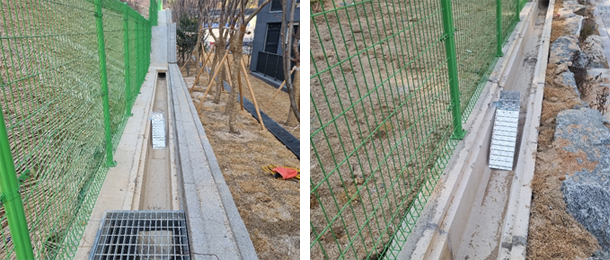
HL D&I Halla carries out a range of biodiversity conservation activities to minimize habitat fragmentation caused by construction and ensure that construction activities remain compatible with the natural environment. At the Cheongju Wolmyeong Park Project, the Company created ecological corridors using existing drainage channels to maintain ecological connectivity within the park. A total of 17 ecological corridors were installed to enable amphibians, including frogs, and small wildlife to move safely into and out of the park. These corridors help mitigate habitat fragmentation caused by construction and maintain ecosystem continuity. The corridors were designed using existing drainage facilities, thereby providing an efficient ecological conservation solution tailored to site conditions. Going forward, HL D&I Halla will contribute to biodiversity conservation through environmentally friendly construction that balances development and conservation and will continue to realize sustainable construction in harmony with nature.

Ecological Corridors at Cheongju Wolmyeong Park