Risk Management

Risk Management System

Risk Reporting System

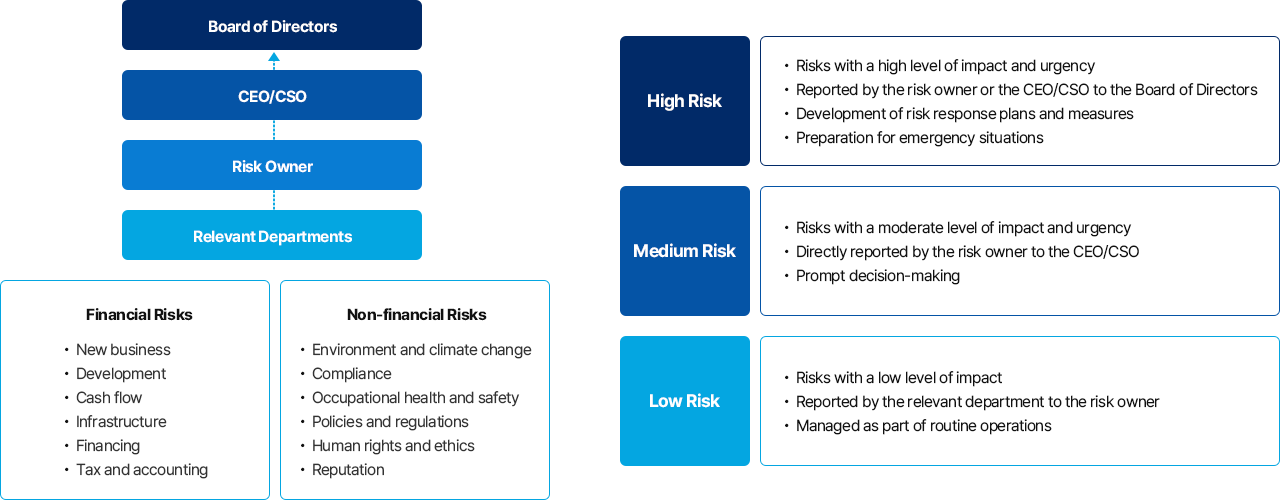
HL D&I Halla operates a company-wide risk management system to proactively identify and respond to potential risks that may arise across its business activities. Risks are categorized and managed as financial and non-financial risks and are classified into three levels—high, medium and low—according to their impact and severity to ensure a systematic response. For each identified risk, the responsible risk owner assesses its severity in accordance with the risk management process and, where necessary, reports the matter to the CEO/CSO and the Board of Directors to facilitate prompt management-level decision-making. The Board of Directors has ultimate oversight responsibility for the management of major Company-wide risks, while the CEO and CSO oversee the establishment and implementation of risk management strategies. Each business unit and relevant department manages the risks identified within its area of responsibility, and major risks are regularly reported to management and the Board of Directors. Through this phased risk management and reporting framework, HL D&I Halla continues to strengthen its capacity to respond to unexpected changes in the business environment while reinforcing the foundation for stable operations and sustainable growth.

Risk Reporting Structure
Risk Management Governance

HL D&I Halla manages financial and non-financial risks in an integrated manner based on its enterprise-wide risk management system and has established clear lines of responsibility and reporting to ensure the effective operation of risk management. The Company has designated the Chief Safety Officer (CSO) as the executive responsible for managing non-financial risks, with oversight of key environmental, social, and governance-related risks. The CSO comprehensively reviews the results of the materiality assessment, major environmental and social risks, and sustainability management performance, and regularly reports the findings to the CEO. The CSO also reports the management status of major non-financial risks and relevant response strategies to the Board of Directors, which oversees and makes decisions on such risks. Financial risks, meanwhile, are managed by the Finance Department and other relevant departments, and major financial risks and the status of response measures are reported directly to the Board of Directors. Through this structure, HL D&I Halla manages financial and non-financial risks separately while maintaining integrated oversight from a company-wide perspective. Major risks are regularly reported to the Board of Directors, and ad hoc reporting is conducted when necessary to ensure a prompt response.

Risk Management Process

Based on its enterprise-wide risk management framework, HL D&I Halla systematically identifies and manages potential risks that may arise across all areas of its business activities. First, the Company identifies and defines key and potential risks by considering changes in the internal and external business environment and its business activities, and analyzes the potential impact of each risk on its operations. The identified risks are then assessed based on their likelihood and impact to determine the level of risk. Based on the assessment results, response strategies are established for each risk level, and relevant management activities are implemented to mitigate and control risks. HL D&I Halla also continuously monitors the status of risk management. Where improvements are required, the Company establishes and implements improvement plans based on the assessment results.

Risk Management Process

Step 1

Risk Identification

  • Identify potential risks that may arise from internal and external sources

Step 2

Risk Assessment

  • Assess the impact of risks based on likelihood, impact, and severity
Step 3

Risk Response

  • Evaluate the management system based on the current status of risks
Step 4

Risk Monitoring

  • Establish response strategies and improvement plans

Risk Management

Financial Risks

Foreign Exchange Risk

HL D&I Halla operates an enterprise-wide risk response framework based on documented risk management policies approved by the Board of Directors to minimize the adverse impact of financial market volatility on its financial performance. In particular, the Company recognizes fluctuations in the exchange rates of the US dollar (USD) and the euro (EUR), arising from the expansion of its global business, as major financial risks and continuously monitors foreign currency exposures based on its functional currency. Translation risk arising from overseas operations is proactively managed through foreign currency-denominated trade receivables and other instruments. The Company also regularly conducts sensitivity analyses assuming a 10% fluctuation in the KRW exchange rate against major foreign currencies to assess the potential impact on profit after tax and equity. Based on its rigorous foreign exchange risk management policy approved by the Board of Directors, HL D&I Halla proactively responds to market uncertainty and continues to secure stability in its business performance.

Interest Rate Risk

HL D&I Halla manages changes in interest income and expenses on deposits and borrowings resulting from future market interest rate fluctuations as a key financial risk. Interest rate risk primarily arises from financial instruments bearing floating interest rates and may directly affect the consolidated entity’s profit or loss and equity. Accordingly, the Company’s key risk management objective is to maximize corporate value by proactively mitigating uncertainties arising from interest rate fluctuations and minimizing net interest expenses. To support this objective, HL D&I Halla regularly conducts sensitivity analyses to assess the impact of a 1% change in interest rates on profit or loss and equity, assuming that all other variables remain constant as of the end of the reporting period. Based on this systematic review framework, the Company optimizes its level of interest rate exposure and maintains a sound and stable financial position.

Liquidity Risk

HL D&I Halla operates an enterprise-wide liquidity risk management system to ensure that it can meet its operating funding requirements in a timely manner and maintain financial soundness even amid unexpected market volatility. The Company continuously monitors cash flows through liquidity forecasting models and maintains unused borrowing facilities at an appropriate level to proactively prepare for potential risks. In particular, HL D&I Halla conducts detailed liquidity analyses linked to its financing plans to prevent breaches of borrowing covenants. The analyses comprehensively review compliance with internal target financial ratios as well as external regulatory and legal requirements relating to financing and currency restrictions, thereby enhancing the completeness of its risk management framework. Based on this rigorous liquidity monitoring system, HL D&I Halla establishes a stable capital structure and strengthens the foundation for resilient and sustainable growth amid rapidly changing global economic conditions.

Non-financial Risks

Risk Type Risk Definition Impact on Business Management Activities
Climate Change
  • Strengthening of greenhouse gas reduction policies and carbon emissions regulations
  • Increasing frequency of extreme weather events, including heat waves, heavy rainfall, and typhoons
  • Growing demand for green construction methods and the application of low-carbon technologies
  • Potential increase in costs associated with carbon emissions management and reduction measures
  • Potential suspension of site operations and delays in construction schedules due to extreme weather events
  • Increased project execution burden arising from the expanded adoption of green construction methods and low-carbon technologies
  • Potential decline in profitability due to higher project costs and construction delays
  • Reduce greenhouse gas emissions to mitigate carbon tax expenses
  • Monitor extreme weather events and develop measures to minimize construction delays
  • Measure and manage supply chain greenhouse gas emissions, including Scope 3 emissions
  • Expand R&D into new and alternative technologies to facilitate the transition to low-carbon technologies
Safety and Health
  • Strengthening of occupational safety and health regulations, including the Serious Accidents Punishment Act
  • Possibility of industrial accidents arising from high-risk working environments at construction sites
  • Increased safety accident risks due to deteriorating working conditions caused by climate change, including extreme heat and cold waves
  • Potential suspension of construction, administrative fines, and legal sanctions in the event of a serious accident
  • Damage to corporate reputation and reduced competitiveness in securing new contracts following a safety accident
  • Increased project operating burden due to work stoppages and higher safety management costs
  • Provide safety and health information and foster a site-level safety culture by holding a Commitment Convention for the Prevention of Serious Accidents
  • Proactively address risk factors through digital-based risk assessments and daily Tool Box Meetings (TBMs) for workers
  • Conduct seasonal health management activities, including summer heat-related illness prevention training, winter hypothermia prevention guidance, and cold prevention campaigns
Supply Chain
  • Supply chain risks arising from partners’ violations of ethics and compliance requirements or inadequate ESG management
  • Project execution risks caused by fluctuations in construction material prices and instability in material supply
  • Strengthening of regulations relating to fair trade and subcontracting
  • Potential decline in corporate credibility and ESG ratings due to inadequate supply chain management
  • Potential disruption in material procurement and delays in construction schedules
  • Increased legal sanctions and business operating risks in the event of compliance violations by partners
  • Enhance partners’ practical ESG management capabilities through ESG assessments and training
  • Strengthen long-term partnerships with key partners through shared growth programs, technology competitions, and other initiatives
  • Present the Four Major Fair Trade Practices and establish a management framework based on the Compliance Program (CP)
Information Security
  • Increasing cybersecurity threats, including hacking, ransomware, and internal information leakage
  • Information protection risks arising from inadequate management of personal information and confidential corporate information
  • Increasing security vulnerabilities in information systems due to the expansion of digital transformation
  • Potential business interruption and operational disruption resulting from system breaches and information leakage
  • Potential legal liability and administrative fines in the event of leakage of customer or partner information
  • Damage to corporate credibility and brand value following an information security incident
  • Conduct failure prevention activities and periodic security inspections in cooperation with the HL Group Data Center (GDC)
  • Conduct monthly reviews of access logs for personal information processing systems and maintain information security liability insurance
  • Continuously strengthen technical protection measures, including emergency Windows security updates