Integrity and Ethical Management

Integrity and Ethical Management System

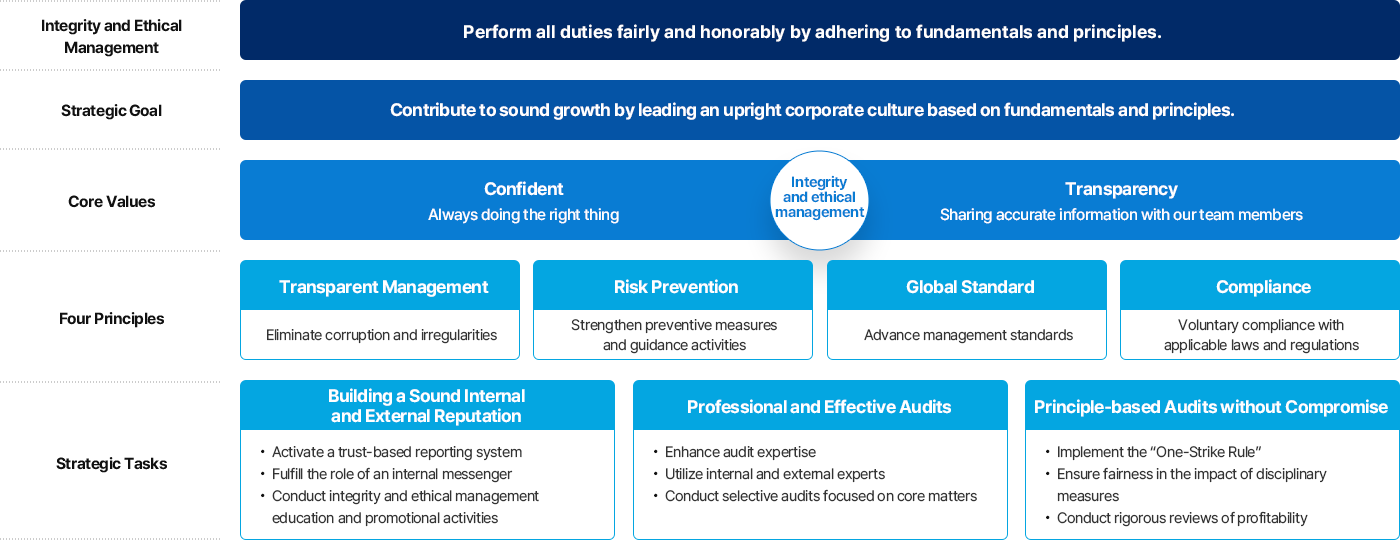
Integrity and Ethical Management Strategy

As a responsible corporate citizen, HL D&I Halla regards integrity and ethical management as one of its core values and is establishing a firmly rooted culture of ethics and compliance. Based on integrity and transparency, the Company strictly adheres to fundamental principles in all business activities and builds sound trust with all stakeholders, including employees and subcontractors. Going forward, HL D&I Halla will continue to advance its implementation framework for creating a fair business ecosystem and faithfully fulfill its role as a responsible company that drives sustainable growth.

Strategic Goal
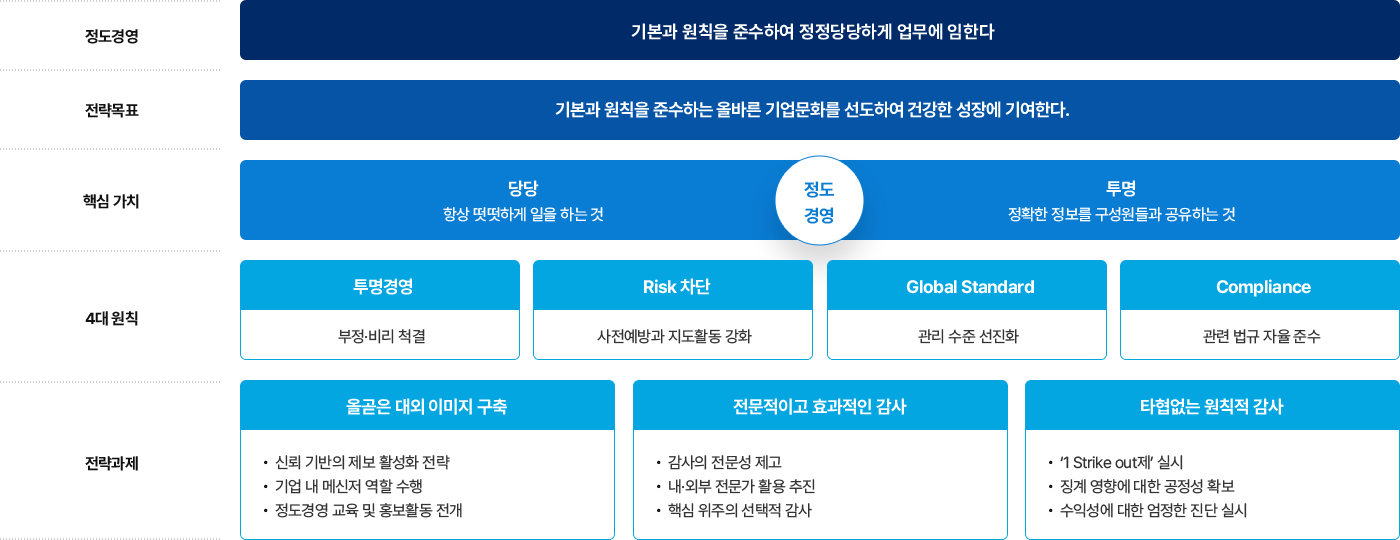
Integrity and Ethical Management Process

Step 1

Prevention

  • Establish and implement the Code of Ethics and Guidelines for Conduct
  • Strengthen ethical leadership
  • Establish an internal control system
  • Promote and provide integrity and ethical management education for employees and subcontractors

Step 2

Monitoring

  • Operate a system for reporting ethical violations and misconduct
  • Conduct internal audits led by the Integrity Management Office (regular, special and theme-based audits)
  • Provide special management of ethics and corruption risks in high-risk areas and business sites
Step 3

Response

  • Investigate reported matters
  • Impose sanctions and corrective measures for ethical violations
  • Identify the causes of violations and establish measures to prevent recurrence
  • Improve customary practices
  • Disseminate exemplary cases and provide rewards

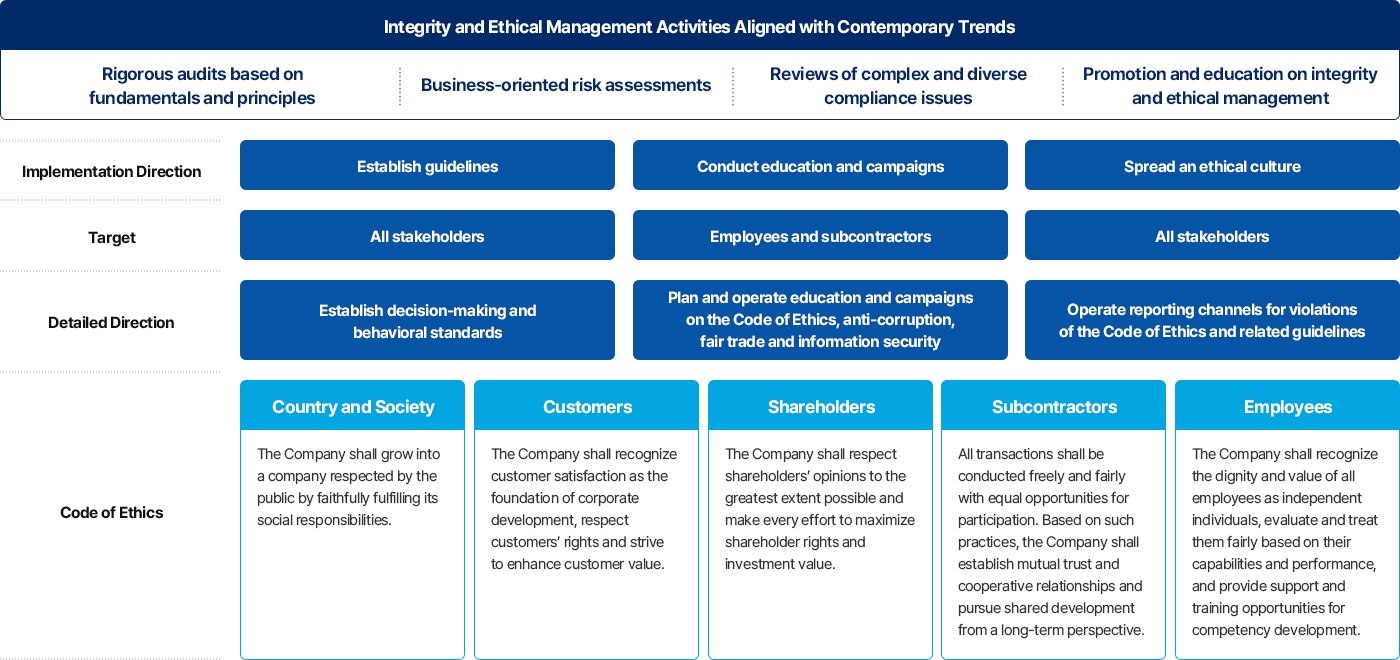
Integrity and Ethical Management Implementation System

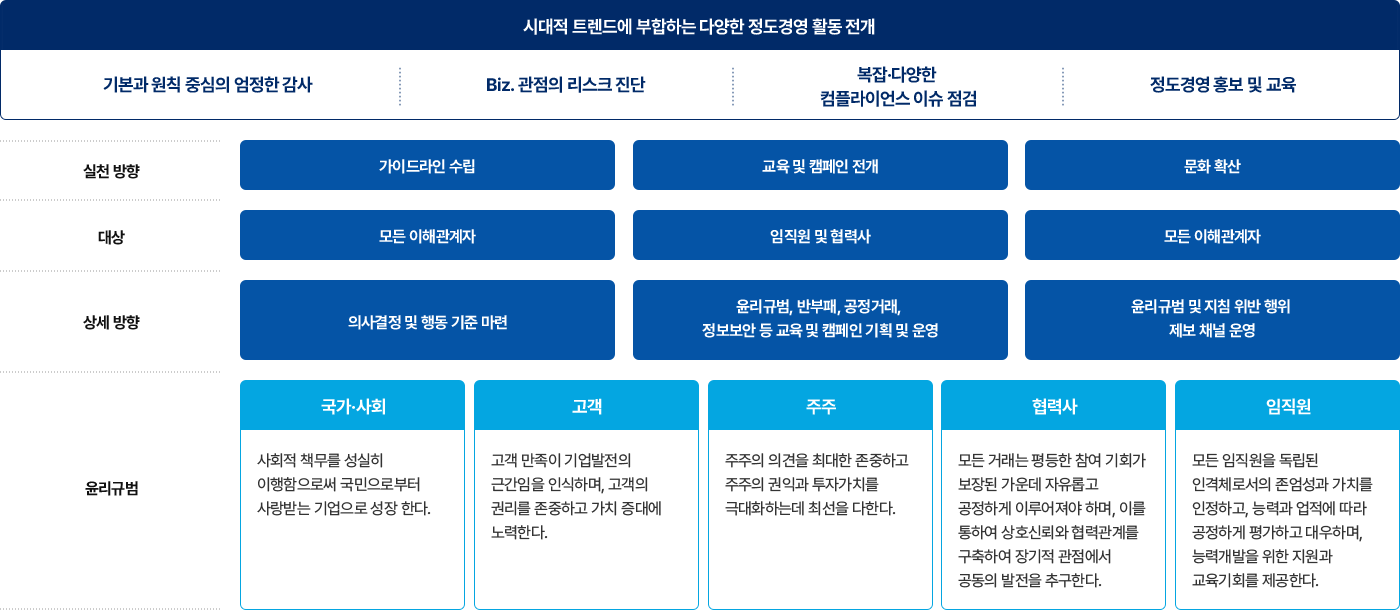
HL D&I Halla has established and operates a systematic integrity and ethical management framework to create a transparent and fair business environment aligned with contemporary trends. Through rigorous audits based on fundamentals and principles and business-oriented risk assessments, the Company proactively responds to diverse and complex compliance issues. Going forward, HL D&I Halla will faithfully implement customized guidelines for key stakeholders, including the government, society, employees, subcontractors, customers and shareholders, and drive sustainable growth as a trusted corporate citizen.

Integrity and Ethical Management Implementation System
Ethical Management Policy

HL D&I Halla has established proper value judgment standards that all stakeholders must observe and has enacted and operates a Code of Ethics to practice responsible management. In particular, the Company has separately established Guidelines for Ethical Conduct containing specific implementation measures to enhance the effectiveness of the Code. These guidelines support employees in making proactive and appropriate judgments in various business situations. The Company clearly stipulates the prohibition of corrupt practices, including the giving and receiving of money, valuables and entertainment, and provides detailed guidelines to prevent misconduct in the course of business. As a company that leads a clean organizational culture, HL D&I Halla will continuously advance its ethical standards and make consistent efforts to internalize ethical awareness among all employees.

Guidelines for Ethical Conduct

Employee Ethics
  • Employees shall comply with domestic and international anti-corruption laws and regulations as members of a global company.
  • Employees shall not engage in improper solicitations that interfere with the fair performance of duties involving other employees or stakeholders.
  • Employees shall not use the Company’s funds, human resources or other assets for political purposes.
Gifts and Monetary Transactions
  • Employees shall neither give nor receive gifts, including cash, merchandise, gift certificates and airline tickets, under any circumstances in dealings with stakeholders.
  • Cash gifts shall not exceed the customary level accepted under social norms.
  • Flowers, wreaths or similar gifts related to promotions, transfers or appointments may be accepted from stakeholders only at a modest level.
  • When employees unavoidably receive gifts against their will, they shall return them immediately.
  • Where returning such gifts is difficult, they shall report them to the Integrity Management Office.
Entertainment and Hospitality
  • Employees shall neither provide nor receive entertainment from stakeholders where it exceeds generally accepted business customs.
  • Employees shall not receive entertainment at establishments considered socially inappropriate, regardless of the monetary amount.
Favors
  • Employees shall not receive transportation, accommodation or other favors that impose a financial burden on stakeholders.
  • Employees shall not receive transportation, accommodation, services or similar benefits from stakeholders during internal Company events, including departmental events and club activities.

Integrity and Ethical Management Education and Communication

HL D&I Halla operates education and communication programs to spread its integrity and ethical management culture across the Company and internalize ethical awareness among employees. The Company regularly provides mandatory training using HL Group’s ethical management content to help employees gain an in-depth understanding of the key values of integrity and ethical management and their practical implementation. The scope of training extends beyond all employees to subcontractors, and includes internal accounting management education covering the Code of Ethics, Guidelines for Conduct and internal accounting practices, thereby fostering a transparent and responsible management environment throughout the supply chain. Relevant policies and information are disclosed at all times through the Company website and business portal to improve accessibility. Going forward, HL D&I Halla will build a trusted organizational culture together with stakeholders through continuous education and communication.

Categories of Integrity and Ethical Management Education

Ethics education

Information security

Personal information protection

Internal accounting management

Participation in Policy Communication and Integrity and Ethical Management Education

Category Unit 2023 2024 2025
Integrity and Ethical Management Education1) Total Participants Persons 1,072 1,149 1,195
Training Hours per Person Hours 10.0 12.4 13.1
Ethical Management Communication Policies and Notices Ratio of Employees with Access to Integrity % 100 100 100

1) Integrity and ethical management education includes information security, personal information protection and ethical management education.

Reporting of Unethical Conduct

HL D&I Halla operates multiple reporting channels through which any stakeholder may submit a report anonymously to eradicate unethical conduct and promote a culture of integrity. The Company maintains channels that prioritize reporter convenience, including the Cyber Reporting Center, telephone, fax, mail and mobile reporting. Reported matters are thoroughly investigated by the HL Group Integrity Management Office and the HR Team in accordance with the principle of fairness. Where unethical conduct is substantiated, strict action is taken pursuant to personnel regulations under the principle of zero tolerance, thereby enhancing the effectiveness of ethical management. In particular, through its whistleblower protection system, the Company strictly maintains the confidentiality of reporters’ identities and operates security measures designed to prevent secondary harm. Going forward, HL D&I Halla will continue to strengthen its ethical management system to create a fair and transparent corporate culture.

Reporting and Investigation Procedure

Step 1

Submission of Report

  • Reports may be submitted under a real name or anonymously through the Group Integrated Reporting Center on the Integrity Management website.
  • When using the anonymous reporting option, reporters may access and review processing results using a personal identification ID and password.
Step 2

Review of Reported Information

  • Apply the principle of protecting the reporter’s identity
  • Conduct a preliminary procedure through the relevant department regarding the reported matter
Step 3

Initiation of Investigation

  • Establish a plan specifying investigators and the investigation period
  • Conduct the investigation sequentially in accordance with the order in which reports were received
  • Adjust the investigation period depending on the subject and scope of investigation
Step 4

Completion of Investigation

  • The investigation is completed once objective evidence has been secured and the facts have been verified.
Step 5

Closure and Notification of Results

  • Take disciplinary action or close the case in accordance with internal regulations
  • Provide feedback on the processing results to the reporter

Reports of Unethical Conduct in 2025

Category Unit Performance Data
Reports of Unethical Conduct Received Cases 19
Reports of Unethical Conduct Investigated Cases 101)
Reports Resulting in Disciplinary Action Cases 2

1) Of the 19 reports received, action was taken on ten cases. The remaining nine include cases transferred to other departments due to insufficient grounds for investigation and matters closed because they were outside the scope of reporting.

Fair Trade Practices

HL D&I Halla faithfully implements the Four Major Fair Trade Practices to establish fair transaction practices between principal contractors and subcontractors and spread a culture of shared growth. The Company uses standard contracts to ensure compliance with fair trade principles when entering into agreements and operates the Subcontracting Internal Review Committee to assess the fairness and legal compliance of transactions in advance. In particular, HL D&I Halla prevents unfair trade practices that may arise during transactions through the use of standard subcontract agreements, operation of the Subcontracting Internal Review Committee, appropriate issuance and retention of written documents, and fair selection and management of subcontractors. The Company also regularly reviews related systems and their operation to strengthen the foundation for shared growth with subcontractors. Going forward, HL D&I Halla will continuously advance its fair trade compliance system and contribute to creating a sound supply chain ecosystem in which the Company and its subcontractors grow together.

Four Major Fair Trade Practices

Desirable Contracting Practices

The Company strives to establish reasonable and fair transaction practices between large enterprises and SMEs and to enter into desirable contracts.

Subcontracting Internal Review Committee

The Company operates a Subcontracting Internal Review Committee to independently review the fairness and legal compliance of subcontracting transactions in advance.

Desirable Issuance and Retention of Written Documents

The Company clearly stipulates requirements concerning the issuance of written documents during subcontracting transactions and ensures the proper exercise of rights and performance of obligations, thereby supporting the spread and establishment of a written-document culture.

Fair Selection and Management of Subcontractors

The Company seeks to establish a fair subcontracting order by enhancing transparency and fairness in the selection and management of subcontractors working with HL D&I Halla.

2025 HL D&I Halla Fair Trade Training

HL D&I Halla conducted the “2025 HL D&I Halla Fair Trade Training” for employees responsible for major fair trade-related duties to promote a culture of fair trade and compliance management. In 2025, a total of 60 personnel from the Shared Growth Team, Outsourcing Procurement Team, Infrastructure PM, Architecture PM, Technology Team and Internal Control completed eight hours of professional training. Reflecting the characteristics of the construction industry, the training curriculum focused on practical matters under the Framework Act on the Construction Industry, the Act on Contracts, the Fair Transactions in Subcontracting Act and ethical management. It emphasized improving employees’ understanding of fair trade-related regulations and preventing risks that may arise during business activities. Customized training reflecting job-specific characteristics was also provided to enhance employees’ practical application and strengthen their ability to comply with fair trade laws and regulations. Through these efforts, HL D&I Halla continues to prevent unfair trade risks in transactions with subcontractors and promote the establishment of a fair and transparent transaction culture and a compliance-based management culture.

Internal Audit

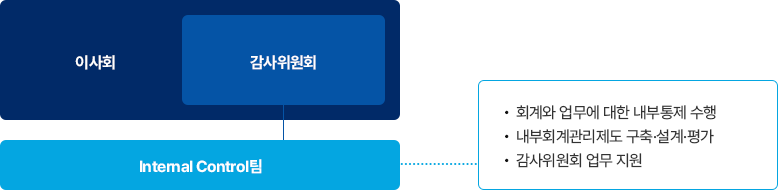
HL D&I Halla operates an Audit Committee independent from the Board of Directors and management to enhance management transparency and practice responsible management. The Audit Committee has the authority to appoint and dismiss the head of its supporting organization, thereby establishing a foundation for the substantive and independent performance of its duties. Separate meetings attended without the external auditor or management are held regularly to ensure the objectivity of audits. The Internal Control Team, a dedicated organization, continuously reviews the reliability of financial reporting and the internal accounting management system. The Company regularly reports the results of inspections conducted by the dedicated organization to the Board of Directors and the Audit Committee. In addition, regular internal audits covering Company-wide matters such as ethical compliance, fair trade, health and safety and human rights are conducted through the HL Group Integrity Management Office to proactively address misconduct and corruption risks. The Company imposes strict sanctions and disciplinary measures in accordance with its regulations for violations identified through audits and establishes recurrence-prevention measures to embed an ethical culture throughout the organization.

HL D&I Halla Audit System

Risk Management Process

Step 1

Risk Identification

  • Identify potential risks that may arise internally and externally.
Step 2

Risk Assessment

  • Assess impact based on likelihood, impact and level of risk.
Step 3

Risk Response

  • Establish response strategies and improvement plans.
Step 4

Risk Monitoring

  • Evaluate the management system in consideration of the current status of risks.

Audit Committee Performance

Category Unit 2023 2024 2025
Total Number of Audit Committee Members Persons 3 3 3
Number of Outside Directors Persons 3 3 3
Number of Audit Committee Meetings Meetings 5 7 5

2025 Internal Audit Performance of the Integrity Management Office

Number of Findings Identified through Audits

Category Unit Total
Business Improvements Cases 30
Risk Management 4
Cost Reduction 3
Best Practices 1
6 Regular Audits
2 Special Audits

Personnel Measures
Resulting from Audits

Total: 16 cases Minor disciplinary measures: 7 cases + Severe disciplinary measures: 9 cases

Internal Accounting Management System

HL D&I Halla operates an internal accounting management system to improve the accuracy of financial information, protect assets and effectively prevent fraud. The Company systematically manages the entire process, from the design of internal control activities to their actual operation, and regularly provides job-related training to control performers and responsible personnel to maximize the system’s effectiveness. In particular, monitoring and evaluations are conducted twice a year, focusing on key control items established based on the RCM (Risk & Control Matrix), thereby ensuring the stability of the risk management framework. Operational status is transparently reported to the Board of Directors and Audit Committee each year, supporting management’s responsible management practices. Going forward, HL D&I Halla will maintain the integrity of financial reporting through continuous monitoring and improvement and create a transparent management environment trusted by stakeholders.

Internal Control Monitoring Items

Internal Control Monitoring Process

Step 1

Monitor Control Items

Step 2

Identify Exceptions

Step 3

Determine Risk Type

Step 4

Implement Business Improvement Measures

Step 5

Confirm Implementation Status

Basis for Operating the Internal Accounting Management System

Category Basis Details
Laws and Regulations Act on External Audit of Stock Companies, Etc. and related enforcement rules Article 8 of the Act on External Audit of Stock Companies, Etc. / Article 9 of the Enforcement Decree
Enforcement Rules on External Audits and Accounting
Model Standards Conceptual Framework for the Internal Accounting Management System Presents the conceptual framework for the design and operation of the internal accounting management system
Internal Regulations Internal Accounting Management System Regulations Chapter 3 of the Internal Accounting Management Regulations

Internal Accounting Education

HL D&I Halla regularly provides professional training for relevant personnel to ensure the effective operation of the internal accounting management system and the integrity of financial reporting. The curriculum focuses on ensuring that responsible personnel remain qualified and professionally competent by covering legal requirements, the latest accounting standards and changes in reporting regulations. In particular, in 2025, training on strengthening internal controls was conducted with “Risk of Misappropriation of Funds,” which may undermine management stability, selected as the core topic. To prevent training gaps caused by personnel transfers, the same course was divided into two sessions, ensuring that all responsible personnel completed the training. Going forward, HL D&I Halla will advance its internal control capabilities through systematic, practice-oriented education and firmly maintain a reliable financial reporting system.

Participants in Internal Accounting Education

[Audit Committee] All Audit Committee members

Entity-Level Control(ELC, Entity Level Control)

[Management] CEO, Internal Accounting Manager (CFO), Executives responsible for accounting and internal accounting management

[Accounting and Tax Personnel] All members of the Accounting Team

[System Operation] Internal Control Team Internal accounting personnel in each team

Internal Reporting System

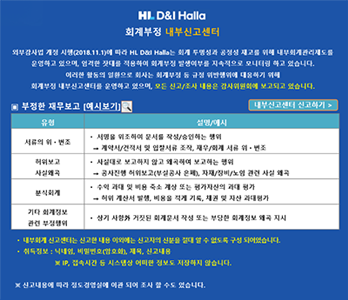
HL D&I Halla proactively detects and prevents misconduct that may create financial risks, including document forgery and falsification and false reporting, through its intranet-based Internal Reporting Center. An independent department directly receives and processes reports so that any employee may raise concerns without restriction. The Company has also established a protection framework that fully safeguards reporters’ anonymity and rights. Through this continuous monitoring system, HL D&I Halla will firmly embed a sound internal control culture and maintain a transparent management environment trusted by stakeholders.

Disclosure on the Internal Reporting Center Bulletin Board

0 Case

2025 Internal Reporting System Number of Reports Received and Processed